
Thermacell Devices and How They Work
Learn about effective ways to manage mosquitoes during peak seasons! Thermacell devices offer proven, and safe protection against those pesky mosquitoes.

How Thermacell Devices Work
Thermacell devices are spatial repellents, meaning they don't primarily protect your skin like DEET. Instead, they create a protective zone in the surrounding air by slowly vaporizing a volatile insecticide/repellent. Mosquitoes entering that zone become disoriented, repelled, or exposed to concentrations that impair their ability to locate and bite humans.
Depending on the model, Thermacell devices can use different active ingredients:
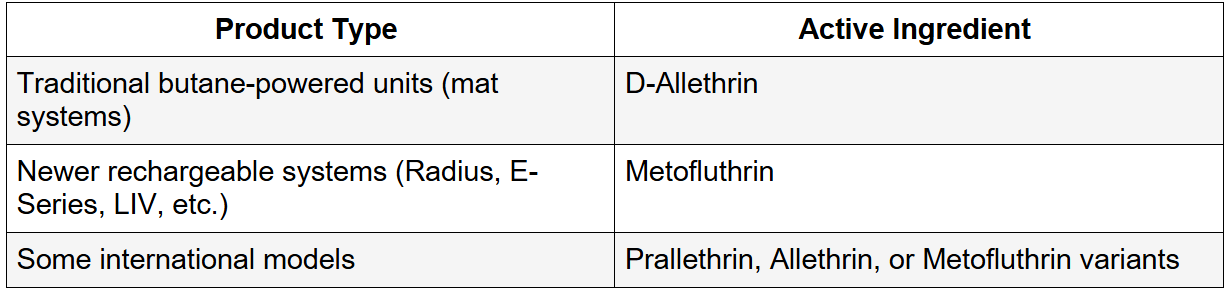
What Exactly Are These Chemicals?
1. Metofluthrin
Metofluthrin is a synthetic pyrethroid developed specifically to be highly volatile, allowing it to evaporate into the air and function as a spatial repellent. It is EPA-registered for mosquito control and is considered one of the most effective vapor-phase mosquito repellents available.
Mechanism:
Acts on insect voltage-gated sodium channels
Disrupts normal nerve signaling
Causes avoidance behavior, knockdown, and death at higher exposures
Mosquitoes do not need to touch it; inhalation of tiny amounts is sufficient to alter behavior.
2. D-Allethrin
Allethrin is an older synthetic pyrethroid derived from the chemistry of natural pyrethrins found in chrysanthemum flowers. Like metofluthrin, it affects insect nerve sodium channels and is released by heating impregnated mats.
How Effective Is It?
Laboratory Studies
A 2019 study evaluating metofluthrin spatial repellents found:
- 80% reduction in mosquito bites.
- 40% mosquito knockdown during arm-in-cage testing.
Multiple field studies show:
- Landing rates reduced 48-67% depending on concentration and deployment.
- Mosquito populations reduced about one-third in community deployment studies.
- Human biting rates reduced up to 79-94% in some real-world deployments.
- Effective even against some pyrethroid-resistant mosquitoes.
Thermacell devices generally perform best in these conditions:
- Little or no wind
- Patios and decks
- campsites
- Stationary activities
Performance decreases substantially when wind disperses the vapor cloud. This is a common theme in both user reports and field testing.
Is it Toxic?
In standard toxicology testing, Metofluthrin has mixed toxicity reports, but overall low toxicity reports. With low oral and dermal toxicity, slight inhalation toxicity, and minimal skin and eye irritation. The EPA classified metofluthrin as having relatively low mammalian toxicity at expected exposure levels.
Like all pyrethroids, metofluthrin and allethrin target sodium channels. At sufficiently high exposures, pyrethroids can cause:
- Paresthesias (tingling)
- Burning sensations
- Dizziness
- Headache
- Tremor
- Nausea
These effects are usually temporary. Pyrethroid-induced paresthesia is a well-known phenomenon among pesticide toxicologists.
One reviewer described transient numbness/tingling after spilling concentrated metofluthrin refill liquid on their skin. While anecdotal, it is consistent with known pyrethroid neurotoxicity.
Long-Term Human Toxicity:
This is where evidence is less complete.
Current regulatory reviews generally conclude:
- No convincing evidence of carcinogenicity at expected consumer exposures.
- No evidence of significant reproductive toxicity at typical exposures.
- No evidence that occasional outdoor use causes chronic neurologic disease.
However, Long-term human exposure studies are limited. Most data come from animal toxicology and occupational exposure literature. Pyrethroids as a class remain under active investigation regarding potential neurodevelopmental effects from chronic exposure.
Effects on Pets:
Cats are generally the most sensitive species to pyrethroids because of reduced glucuronidation capacity. Dogs appear less sensitive but can develop neurologic signs after significant exposure. While Thermacell products are EPA-approved when used according to directions, concentrated refill liquids should be considered potentially hazardous if Ingested, applied directly, or spilled on pets
Environmental Toxicity and Impacts on Animals.. .
This is probably the biggest concern. Like many pyrethroids, Metofluthrin is highly toxic to aquatic life, fish and aquatic invertebrates in particular.
With animals such as Pollinators the situation is more complicated. Laboratory toxicology suggests pyrethroids can be harmful to bees and other insects. However, one 2024 study examining airborne metofluthrin from Thermacell E90 devices found no measurable impairment of honey bee learning or memory under the study conditions.
That does not prove absence of environmental effects, but it suggests that vapor-phase exposure may be less harmful to bees than direct insecticide spraying.
Overview
Ranking mosquito control methods by efficacy:
- Thermacell (metofluthrin)
- DEET or picaridin on skin
- Permethrin-treated clothing
- Fans
- Citronella/candles (far less effective)
Thermacell's biggest strengths are:
- It's highly effective
- No skin application
- Good user compliance
- Strong field data
Its biggest drawbacks are:
- Uses a neuroactive pyrethroid
- Not ideal around ponds, streams, or aquatic ecosystems
- Potential impacts on non-target insects
- Exposure is environmental rather than targeted to skin
For a healthy adult sitting on a deck a few evenings per week, the toxicologic risk appears quite low based on current evidence. For someone with chemical sensitivities, neurologic illness, or a strong desire to minimize pesticide exposure, alternatives such as fans, source reduction, screened spaces, and topical picaridin may be preferable.
The Bottom Line :
Current evidence supports Thermacell products as Highly effective for reducing mosquito bites. And to be low risk for acute toxicity for most adults when used as directed. However, as with any pesticide, the safety of exposure to infants and young children is less clear and may warrant caution. Fans and screened porches are safe non-toxic alternatives.
Potentially harmful to aquatic organisms and some non-target insects. Not adequately studied for decades-long chronic inhalation exposure. Best viewed as a pesticide-based spatial repellent rather than a "natural" mosquito control method.
References
EPA. Metofluthrin Pesticide Fact Sheet. U.S. Environmental Protection Agency. 2006.
Summary: Regulatory toxicology review supporting registration of metofluthrin in consumer mosquito-repellent products. Reports low acute mammalian toxicity at labeled exposures, while noting high toxicity to aquatic organisms and insects. Provides toxicology, environmental fate, and risk assessment data.
https://www3.epa.gov/pesticides/chem_search/reg_actions/registration/fs_PC-109709_01-Sep-06.pdf
Health Canada. Evaluation Report ERC2015-01: Metofluthrin. Pest Management Regulatory Agency. 2015.
Summary: Independent governmental review concluding that metofluthrin has low acute oral and dermal toxicity, slight inhalation toxicity, minimal skin irritation, and minimal eye irritation under expected use conditions.
https://www.canada.ca/en/health-canada/services/consumer-product-safety/reports-publications/pesticides-pest-management/decisions-updates/evaluation-report/2015/metofluthrin-erc2015-01.html
Lucas JR, Shono Y, Iwasaki T, et al. Field and Laboratory Evaluation of Metofluthrin Spatial Repellents.
Summary: Demonstrated substantial reductions in mosquito landing and biting rates using metofluthrin vapor-emitting devices in outdoor settings. Frequently cited as foundational evidence supporting spatial repellent technology.
https://academic.oup.com/jinsectscience/article/24/5/7/7831962
Ogoma SB, Moore SJ, Maia MF. A Systematic Review of Mosquito Spatial Repellents.
Summary: Comprehensive review of spatial repellent research. Reports reductions in mosquito biting, host-seeking behavior, and disease transmission risk associated with metofluthrin and related pyrethroid repellents.
https://www.ivcc.com/wp-content/uploads/2020/08/An-Expert-Review-of-Spatial-Repellents-for-Mosquito-Control.pdf
Couvillon MJ, et al. Airborne Metofluthrin Does Not Impact Foraging Honey Bees. Journal of Insect Science. 2024.
Summary: Evaluated potential effects of airborne metofluthrin on honey bee behavior. Found no measurable impairment in foraging performance under study conditions, though further ecological research is warranted.
https://pmc.ncbi.nlm.nih.gov/articles/PMC11497606/
Couvillon MJ, et al. A Volatilized Pyrethroid Insecticide from a Mosquito Repelling Device Does Not Affect Honey Bee Foraging and Recruitment. Journal of Insect Science. 2023.
Summary: Study of Thermacell-style pyrethroid vapor technology. No significant effects were observed on honey bee foraging frequency, recruitment, or persistence behaviors.
https://academic.oup.com/jinsectscience/article/23/6/11/7458966
EPA. Pyrethroids: Human Health and Ecological Risk Assessment. U.S. Environmental Protection Agency. 2020.
Summary: Class-wide review of pyrethroid insecticides. Notes generally low mammalian toxicity compared with older pesticide classes but significant toxicity to aquatic organisms and some non-target insects.
https://www.epa.gov/pesticides/epa-addresses-human-health-and-ecological-risks-posed-13-pyrethroids
California Office of Environmental Health Hazard Assessment (OEHHA). Metofluthrin Toxicological Review.
Summary: Review prepared for California regulatory agencies evaluating potential consumer exposures from metofluthrin-containing products and available toxicology data.
https://oehha.ca.gov/media/downloads/crnr/101211metofluthrin.pdf
University of Hertfordshire Pesticide Properties Database (PPDB). Metofluthrin Monograph.
Summary: Independent pesticide database summarizing environmental fate, ecotoxicology, neurotoxicity concerns, persistence, and regulatory classifications.
https://sitem.herts.ac.uk/aeru/ppdb/en/Reports/1235.htm
National Library of Medicine. PubChem Compound Summary: Metofluthrin.
Summary: Chemical profile including structure, CAS number (240494-70-6), physicochemical properties, classification as a synthetic pyrethroid, and toxicological information.
https://pubchem.ncbi.nlm.nih.gov/compound/Metofluthrin
Thermacell. Metofluthrin Ingredient Overview.
Summary: Manufacturer description of metofluthrin technology, mechanism of action, and EP
https://www.thermacell.com/blog/metofluthrin-mosquito-repellent-ingredient
Additional Clinical Perspective
Bradman A, Castorina R, Boyd Barr D, et al. Determinants of Organophosphorus Pesticide Urinary Metabolite Levels in Young Children Living in an Agricultural Community.
Summary: While not specific to metofluthrin, this and related pyrethroid biomonitoring literature provide context regarding human pesticide exposure and the growing interest in long-term neurodevelopmental effects of chronic pyrethroid exposure.
https://ehp.niehs.nih.gov/doi/full/10.1289/ehp.5724